Tuesday, December 21, 2010

ford cars 2010 top

The Ford Motor Company (NYSE: F) is an American multinational corporation based in Dearborn, Michigan, a suburb of Detroit. The automaker was founded by Henry Ford and incorporated on June 16, 1903. In addition to the Ford, Lincoln, and Mercury brands, Ford also owns a small stake in Mazda in Japan and Aston Martin in the UK. Ford's former UK subsidiaries Jaguar and Land Rover were sold to Tata Motors of India in March 2008. In 2010 Ford sold Volvo to Geely Automobile. Ford will discontinue the Mercury brand at the end of 2010.
Ford introduced methods for large-scale manufacturing of cars and large-scale management of an industrial workforce using elaborately engineered manufacturing sequences typified by moving assembly lines. Henry Ford's methods came to be known around the world as Fordism by 1914.
Ford is currently the second largest automaker in the U.S. and the fourth-largest in the world based on number of vehicles sold annually, directly behind Volkswagen Group. In 2007, Ford fell from second to third in US annual vehicle sales for the first time in 56 years, behind only General Motors and Toyota. However, Ford occasionally outsells Toyota in shorter periods (most recently, during the summer months of 2009). By the end of 2009, Ford was the third largest automaker in Europe (behind Volkswagen and PSA Peugeot Citroën).[7] Ford is the eighth-ranked overall American-based company in the 2010 Fortune 500 list, based on global revenues in 2009 of $118.3 billion.[8] In 2008, Ford produced 5.532 million automobiles[9] and employed about 213,000 employees at around 90 plants and facilities worldwide. During the automotive crisis, Ford's worldwide unit volume dropped to 4.817 million in 2009. Despite the adverse conditions, Ford ended 2009 with a net profit of $2.7 billion. Starting in 2007, Ford received more initial quality survey awards from J. D. Power and Associates than any other automaker. Five of Ford's vehicles ranked at the top of their categories and fourteen vehicles ranked in the top three.
Contents
1 History
2 Corporate governance
3 Recent company developments
3.1 "The Way Forward"
3.2 Online
4 Brands and marques
5 Global markets
5.1 Europe
5.2 Asia Pacific
5.3 South America
5.4 Africa and Middle East
6 Environmental initiatives and alternative propulsion systems
6.1 Compressed natural gas
6.2 Flexible fuel vehicles
6.3 Electric vehicles
6.3.1 Hybrid electric vehicles
6.3.2 All-electric vehicles
6.4 Hydrogen
6.5 Increased fuel efficiency
6.6 PC Power Management
7 Auto racing
7.1 NASCAR
7.2 Formula One
7.3 Rally
7.4 Sports cars
7.5 Touring cars
7.6 Other
8 Ford trucks
9 Bus products
10 Ford tractors
11 U.S. Sales
11.1 Fleet Sales
12 Criticism
12.1 Alleged Nazi collaboration
12.2 Argentine "Dirty War"
12.3 Ford Pinto
13 See also
14 Notes
15 References and further reading
15.1 Ford Motor Company
16 External links
History
Henry Ford (ca. 1919)
1896 Ford Quadricycle
Main article: History of Ford Motor Company
The Ford Motor Company was launched in a converted factory in 1903 with $28,000 in cash from twelve investors, most notably John and Horace Dodge (who would later found their own car company). Henry's first attempt under his name was the Henry Ford Company on November 3, 1901, which became the Cadillac Motor Company on August 22, 1902. During its early years, the company produced just a few cars a day at its factory on Mack Avenue in Detroit, Michigan. Groups of two or three men worked on each car from components made to order by other companies. Henry Ford was 40 years old when he founded the Ford Motor Company, which would go on to become one of the world's largest and most profitable companies, as well as being one to survive the Great Depression. As one of the largest family-controlled companies in the world, the Ford Motor Company has been in continuous family control for over 100 years.
ford
ford
ford
ford
ford
ford
ford
ford
ford
ford
ford
ford
ford

Monday, December 20, 2010

sports cars early history

A sports car has been defined as "an open, low-built, fast motor car." Sports cars have been either spartan or luxurious,[3] but driving and mechanical performance is requisite. A sports car does not require a large, powerful engine, though many do have them. Many classic British sports cars lacked powerful engines, but were known for exceptional handling due to light weight; a well-engineered, balanced chassis; and modern suspension (for example, Lotus Seven, Austin 7 Speedy).
Contents
1 Early history
2 Layout
3 Seating
4 Sports car versus sporting models
5 See also
6 References
7 External links
Early history
1934 Aston Martin Ulster
The sports car traces its roots to early 20th century touring cars. These raced in early rallys, such as the Herkomer Cup, Prinz Heinrich Fahrt, and Monte Carlo.
The first true sports cars (though the term would not be coined until after World War One) were the 3 litre made in 1910 Vauxhall 20 hp (15 kW) and 27/80PS Austro-Daimler (designed by Ferdinand Porsche).
These would shortly be joined by the French DFP (which became sporters after tuning by H.M. and W. O. Bentley) and the Rolls-Royce Silver Ghost. In the U.S. (where the type was variously called roadster, speedster, runabout, or raceabout, there was Apperson, Kissel, Marion, Midland, National, Overland, Stoddard-Dayton, and Thomas among small models (which today would be called sports cars), while Chadwick, Mercer, Stutz, and Simplex were among large ones (which might today be called sports sedans or grand tourers).[4]

In 1921, Ballot premiered its 2LS, with a remarkable 75 hp (56 kW) DOHC two liter, designed by Ernest Henry (formerly of Peugeot's Grand Prix program), capable of 150 km/h (90 mph); at most, one hundred were built in four years. This was followed by the SOHC 2LT and 2LTS. The same year, Benz built a supercharged 28/95PS four for the Coppa Florio; Max Sailer won.[4]
Simson in 1924 offered a Paul Henze-designed 60 hp (45 kW) DOHC 2 liter four, the Simson Supra Type S, in a long-wheelbase 120 km/h (60 mph) tourer and 115 km/h (71 mph) twin-carburettor sporter; only thirty were sold, against around three hundred of the SOHC model and 750 of the pushrod-six Type R. Duerkopp's Zoller-blown two liter in 1924, as well.
There was a clear cleavage by 1925. As four-seaters were more profitable, two-seaters increasingly turned over to specialst manufacturers, led by Alvis, Aston-Martin, and Frazer-Nash, with shoestring budgets, fanatic followers, and limited sales (today exemplified by Aston and Morgan): between 1921 and 1939, 350 Astons were built; 323 Frazer-Nashes in the period 1924-39.
By the end of the 1920s, AC produced a 2 liter six, the 3.5 liter Nazzaro had a three-valve OHC (only until 1922), while French makers Amilcar, Bignan, Hispano-Suiza, and Samson had the typical small four-cylinder sporters and Delage, Hotchkiss, and Chenard-Walcker the large tourers. Benz introduced the powerful SS and SSK, and Alfa Romeo, the Vittorio Jano-designed 6C.
Two companies would offer the first really reliable sports cars: Austin with the Seven and Morris Garages (MG) with the Midget. The Seven would quickly be "rodded" by numerous companies (as the Type 1 would be a generation later), including Bassett and Dingle (Hammersmith, London); in 1928, a Cozette blower was fitted to the Seven Super Sports, while Cecil Kimber fitted an 847 cc Minor engine, and sold more Midgets in the first year than MG's entire previous production
sports cars
sports cars
sports cars
sports cars
sports cars
sports cars
sports cars
sports cars
sports cars
sports cars
sports cars
sports cars
sports cars
sports cars
sports cars
sports cars
sports cars
sports cars
sports cars
sports cars
sports cars
sports cars

jeep top

Jeep is an automobile marque of Chrysler. It is the oldest off-road vehicle (also sport utility vehicle – SUV) brand. It inspired a number of other military Light Utility Vehicles, such as the Land Rover which is the second oldest 4-wheel-drive brand. The original Jeep vehicle that first appeared as the prototype Bantam BRC became the primary light 4-wheel-drive vehicle of the United States Army and Allies during World War II, as well as the postwar period. Many Jeep variants serving similar military and civilian roles have since been created in other nations.
Contents
1 History
1.1 Origin of the name "jeep"
1.2 Trade name
1.3 The origins of the vehicle: the first jeeps
1.3.1 The M715
2 The Jeep marque
2.1 AM General
3 Off-road abilities
4 Summary of Jeep ownership
5 Jeep model list
5.1 Historical and military models
5.2 FC Trucks, VJ Jeepsters, & FJ Vans
5.3 CJ models
5.4 DJ models
5.5 SJ (FSJ) models
5.6 XJ models
5.7 MJ models
5.8 YJ, TJ, LJ and JK models
5.9 ZJ, WJ, and WK models
5.10 KJ models
5.11 Current models
5.12 Concept vehicles
6 Jeeps around the world
7 See also
8 References
9 External links
There are many explanations of the origin of the word "jeep," all of which have proven difficult to verify. The most widely held theory is that the military designation of GP begat the term "Jeep" and holds that the vehicle bore the designation "GP" (for "Government Purposes" or "General Purpose"), which was phonetically slurred into the word jeep. However, an alternate view launched by R. Lee Ermey, on his television series Mail Call, disputes this, saying that the vehicle was designed for specific duties, and was never referred to as "General Purpose" and it is highly unlikely that the average jeep-driving GI would have been familiar with this designation. The Ford GPW abbreviation actually meant (G for government use, P to designate its 80-inch (2,000 mm) wheelbase and W to indicate its Willys-Overland designed engine).
Many, including Ermey, suggest that soldiers at the time were so impressed with the new vehicles that they informally named it after Eugene the Jeep, a character in the Popeye cartoons created by E. C. Segar. Eugene the Jeep was Popeye's "jungle pet" and was "small, able to move between dimensions and could solve seemingly impossible problems."
Words of the Fighting Forces by Clinton A. Sanders, a dictionary of military slang, published in 1942, in the library at The Pentagon gives this definition:
Jeep: A four-wheel drive vehicle of one-half- to one-and-one-half-ton capacity for reconnaissance or other army duty. A term applied to the bantam-cars, and occasionally to other motor vehicles (U.S.A.) in the Air Corps, the Link Trainer; in the armored forces, the ½-ton command vehicle. Also referred to as "any small plane, helicopter, or gadget."
This definition is supported by the use of the term "jeep carrier" to refer to the Navy's small escort carriers.
Early in 1941, Willys-Overland demonstrated the vehicle's off-road capability by having it drive up the steps of the United States Capitol, driven by Willys test driver Irving "Red" Haussman, who had recently heard soldiers at Fort Holabird calling it a "jeep." When asked by syndicated columnist Katherine Hillyer for the Washington Daily News (or by a bystander, according to another account) what it was called, Irving answered, "It's a jeep."
Katherine Hillyer's article was published nationally on February 20, 1941, and included a picture of the vehicle with the caption:
LAWMAKERS TAKE A RIDE- With Senator Meade, of New York, at the wheel, and Representative Thomas, of New Jersey, sitting beside him, one of the Army's new scout cars, known as "jeeps" or "quads", climbs up the Capitol steps in a demonstration yesterday. Soldiers in the rear seat for gunners were unperturbed.
This exposure caused all other jeep references to fade, leaving the 4x4 with the name. The term was also in military slang use to mean vehicles that were untried, or untested.
Trade name
The original trademark brand name application was filled in February 1943 by Willys-Overland. It is also used as a generic term with a lowercase (jeep) for vehicles inspired by the Jeep that are suitable for use on rough terrain.
As the only company that continually produced Jeep vehicles after the war, in June 1950 Willys-Overland was granted the privilege of owning the name "Jeep" as a registered trademark
jeep
jeep
jeep
jeep
jeep
jeep
jeep
jeep

ferrari enzo speed car

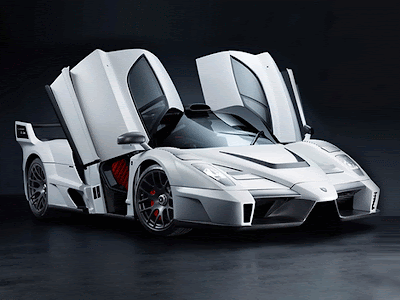
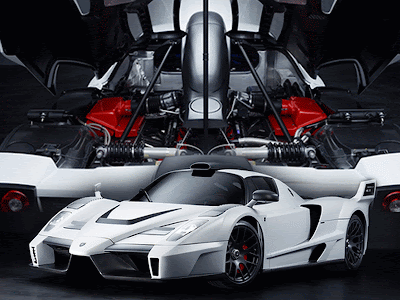
The Enzo Ferrari is a 12 cylinder mid-engine berlinetta named after the company's founder, Enzo Ferrari. It was built in 2002 using Formula One technology, such as a carbon-fibre body, F1-style electrohydraulic shift transmission, and Carbon fibre-reinforced Silicon Carbide (C/SiC) ceramic composite disc brakes. Also used are technologies not allowed in F1 such as active aerodynamics and traction control. After a downforce of 775 kg (1,709 lb) is reached at 355.6 km/h (221 mph) the rear wing is actuated by computer to maintain that downforce.
The Enzo's V12 engine is the first of a new generation for Ferrari. It is based on the architecture of the V8 found in sister-company Maserati's Quattroporte, using the same basic architecture and 104 mm (4.1 in) bore spacing. This design will replace the former architectures seen in V12 and V8 engines used in most other contemporary Ferraris. The 2005 F430 is the second Ferrari to get a version of this new powerplant.
Contents
1 Name
2 Production
3 Specifications
3.1 Engine
3.2 Chassis
3.3 Performance
4 Accolades
5 Enzo-based cars
5.1 Ferrari FXX
5.2 Ferrari P4/5 by Pininfarina
5.3 Maserati MC12
5.4 Maserati Birdcage 75th
5.5 Maserati MC12 Corsa
5.6 Ferrari Millechili
5.7 Ferrari FXX Evoluzione
6 References
7 External links
Name
Though officially known as the Enzo Ferrari or "F60", the car is sometimes referred to colloquially as the "Ferrari Enzo", or simply as "Enzo" with no marque or other words attached.
Celebrating its first World Championship of the new Millennium in Formula One, Ferrari built the Enzo to celebrate this achievement, and named the car after its founder, Enzo Ferrari, who died in 1988.
Production
This section does not cite any references or sources.
Please help improve this article by adding citations to reliable sources. Unsourced material may be challenged and removed. (December 2010)
The Enzo was designed by Ken Okuyama, the Japanese former Pininfarina head designer, and initially announced at the 2002 Paris Motor Show with a limited production run of 349 and at US $659,330. The company sent invitations to existing customers, specifically, those who had previously bought the F40 and F50. All 349 cars were sold in this way before production began. Later, after numerous requests, Ferrari decided to build 50 more Enzos, bringing the total to 399. Before being unveiled at the Paris Motor show, the Enzo (that was used in the show) was flown from Italy to California to be filmed in Charlie's Angels: Full Throttle. It was driven on a beach by actress Demi Moore. After filming was complete, the Enzo was flown to France to be in the Motor Show.[4] Enzos are listed as being built in 2003. In 2003 an Enzo Ferrari delivered to Houston, Texas attorney Dahr Jamail was involved in a driving mishap and was totally consumed by fire. Ferrari made an additional vehicle for Mr. Jamail that carried the same serial number as the destroyed car. This kept the number of Enzo Ferraris at 400.
Ferrari built one more Enzo — the 400th car — and it was auctioned by Sotheby's Maranello Auction on June 28, 2005, to benefit survivors of the 2004 Tsunami for €950,000 (US$1,274,229), almost twice its list price. This sum was presented to Pope Benedict XVI, while former Ferrari Formula One driver Michael Schumacher gave the pope a steering wheel to commemorate the donation. This wheel included a plaque which read, "The Formula 1 World Champion's steering wheel to His Holiness Benedict XVI, Catholicism's driver."
The Enzo Ferrari typically trades above $1,000,000 (£800,000) at auction.
Three prototype "mules" were built, M1, M2, and M3. Each was bodied to look like a 348, even though the mules were built in 2000. The third mule was offered for auction alongside the 400th Enzo in June, 2005, bringing €195,500 (US$236,300).
Engine
Main article: Ferrari Dino engine#V12
The Enzo is a mid-engined car with a 43.9/56.1 front/rear weight distribution. The engine is Ferrari's F140 65° V12 with 4 valves per cylinder, dual overhead cams and variable valve timing. Bosch Motronic ME7 fuel injection is used and the engine is naturally aspirated. It displaces 5998 cc (366 in³) and produces 660 PS (485 kW; 651 hp) at 7800 rpm and 657 N·m (485 lb·ft) at 5500 rpm.[7] The redline is 8000 rpm.
ferrari enzo
ferrari enzo
ferrari enzo
ferrari enzo
ferrari enzo
ferrari enzo
ferrari enzo
ferrari enzo
ferrari enzo
ferrari enzo
Related Posts Plugin for WordPress, Blogger...